Working with Time Tracking
Track estimates and work on issues, compare remaining time, and export timesheets for reporting.
Enable time tracking
Time tracking requires an active Enterprise subscription. Check Administration / Subscription Management, then enable Time Tracking in the project's general settings. The project must also have issue management enabled.
In Administration / Issue Settings / Time Tracking, configure the working hours per day, days per week, and optional aggregation link. With Sub Issues selected, child estimates and work contribute to the parent's totals. Enter a parent's own estimate and work separately; do not enter the child's hours again.
Set estimates and record work
Open an issue and click the circular time indicator beside its state. Use the edit action beside Estimated Time to set an estimate. Values such as 1h 15m and 1d use the working-time units configured by your administrator.
Use Log work to enter spent time, its start date/time, and an optional note. Work entries appear in issue activities and can be corrected with their Edit action.
Alternatively, choose Start work, perform the work, and click Stop work. The stopwatch displays HH:mm. Stopping records whole elapsed minutes; a session shorter than one minute does not create a work entry. Stop the timer explicitly when finished and review the recorded time. Do not rely on automatic midnight stopping or an overnight reminder.
When child aggregation is configured, the popup distinguishes Own, Aggregated, and Total values:
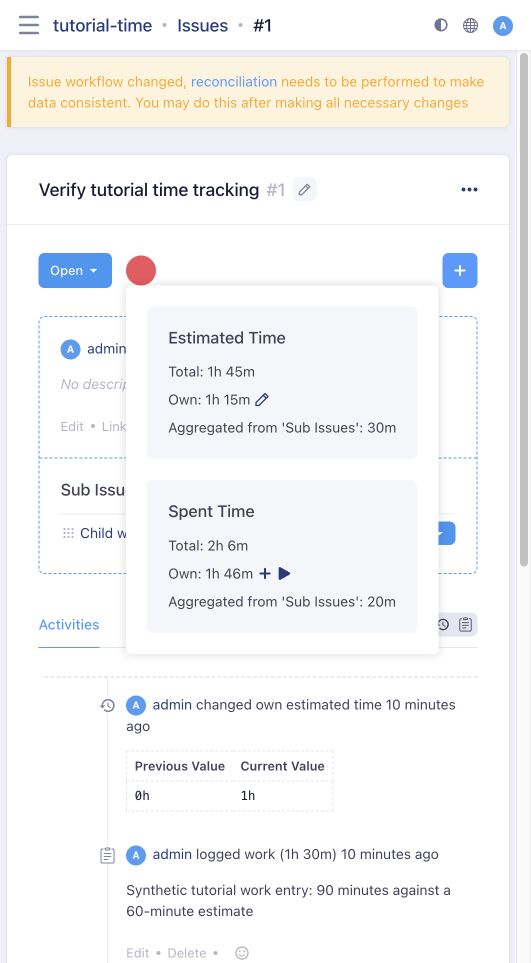
In this example, the parent has 1h 15m of its own estimate and 1h 46m of its own work, including one stopwatch minute. Its child contributes 30m estimated and 20m spent, producing totals of 1h 45m and 2h 6m.
Check progress
The indicator is gray when no estimate is set and turns red when spent time exceeds the estimate. Find issues without an estimate with:
"Estimated Time" is "0"
Find overruns with:
"Progress" is greater than "1"
The Timing action on an issue list shows totals for the matching issues. For an iteration, open Burndown and select Remaining time, Estimated time, or Issue count. Remaining time can be negative when work exceeds estimates. A newly created iteration has little history; it will not immediately reproduce a chart spanning many days.
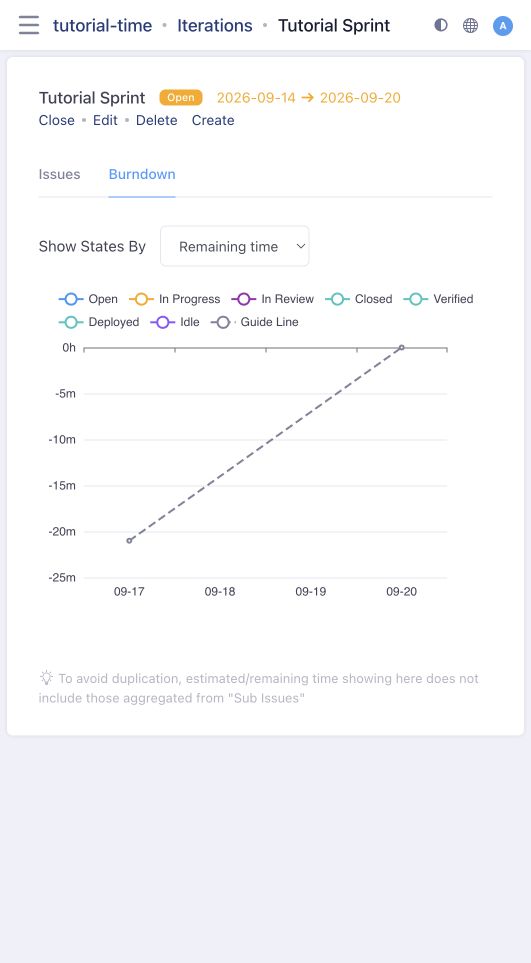
Burndown calculations exclude aggregated child totals to avoid counting the same estimate or work twice.
Create and export timesheets
Open Issues / Timesheets and choose Add New. Specify a name, optional issue filter, whether to show work by Issues or Users, a Week or Month range, and optional grouping such as project. The first timesheet is the default; its name menu lets you manage or add other views.
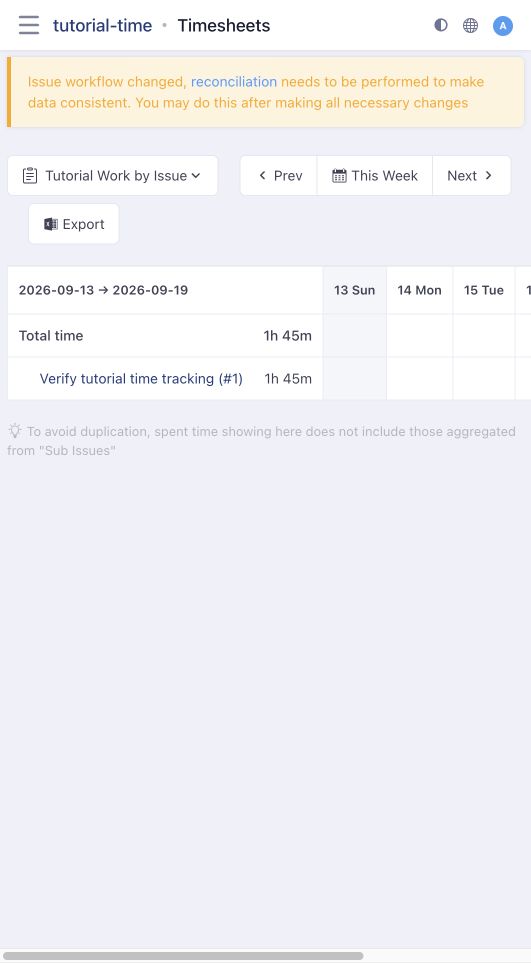
Use Prev, Next, and This Week (or the corresponding month control) to select the period. Click a daily time value to inspect the underlying work. Switch to a user-based view to see who recorded the time.
Timesheets sum each issue's own work, excluding aggregated child totals. For the parent and child above, both issue-based and user-based views total 2h 6m, not the sum of the parent's aggregated total and the child again.
Choose Export to download an Excel workbook for the displayed period. The tutorial's earlier 1h 45m total was verified in both the page and the exported workbook. Timesheet and burndown views can also be added as dashboard widget tabs; see Custom Dashboard.